Wednesday, October 26, 2011

Pompeii

This is a picture of The Road To The Sea in Pompeii with Mount Vesuvius in the background.

I have had a fascination with Pompeii since I was a child.  When we started planning our trip to Italy, Pompeii was the local that I was most excited about visiting.  In 79 AD Mt. Vesuvius erupted and buried Pompeii under a layer of ash and rock.  It is estimated that around 2,000 people died in Pompeii and several casts of citizens entombed by the eruption can be viewed today.  Excavations of Pompeii began in 1748.  Pompeii was a well developed city when Mt. Vesuvius erupted.  The eruption captured the city as if frozen in time.  Over the years, most of the frescoes, elaborate tile mosaics, sculptures and artifacts have been removed to museums, but as you wander through the city you can still see the homes with courtyards, businesses, streets, The Forum, and temples.


This is The Temple in The Forum.

Some of the remaining columns that surround The Forum.

This is a storage room containing some of the artifacts excavated from the ruins.  In the center is a cast made of a man's body.

This is another storage room and another human cast.  The young man seems to be huddled in a corner covering his mouth from the ash.

This picture shows one of the city roads with homes and businesses on either side.  Those large stones in the middle of the road were placed there by the citizens of Pompeii as stepping stones to cross the road during rainy weather.  Groves in the stone thresholds of businesses indicate that the businesses had sliding front doors.

Here is another city street view with a public fountain at the bottom.  You can see more stepping stones in the road.  Some of the streets had deep groves in the road from the wear of the chariot wheels.

This lovely tile design reminds me of a favorite quilt pattern called Tumbling blocks.
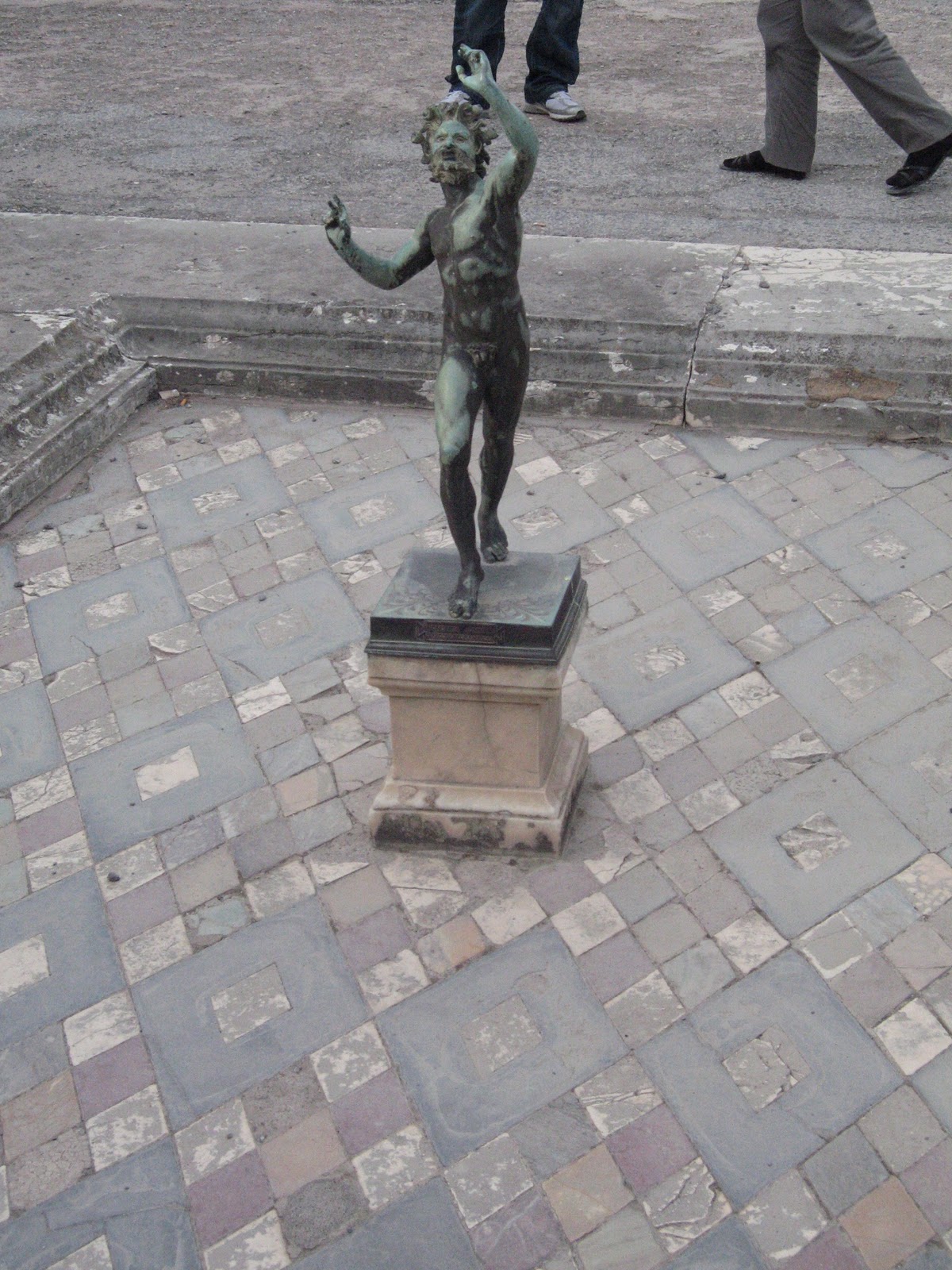
Some of the Villas that were uncovered had courtyards, ponds and sculptures such as the one in this picture.

You can see from this picture that the villas were very elaborate.

 
Here is another home with a pond in the center of the courtyard.

This picture shows a tile mosaic entry to the villa.

Some of the columns were made of bricks covered with mortar.


I was surprised at how large a city Pompeii was. I would have loved to have spent more time wandering it's streets, peeking in it's doors and discovering more of it's secrets.

Tuesday, October 25, 2011

Roaming Through Rome

Entrance to Vatican City

We had two days to explore Rome.  Bob arranged for walking tours each day.  On the first day we toured Vatican City which took us through the Vatican Museum, Raphael's Rooms, the Sistine Chapel, and St. Peter's Cathedral.  The second day in Rome we toured the Colosseum and the ruins around the Forum.  When we weren't on those walking tours we were wandering around the city wishing we had our own personal tour guide to answer all our questions and to tell us where to find excellent pizza and gelato.

This statue is called The Laocoon.  It is a Roman copy of a Greek statue.  It was excavated in Rome in 1506.  Wouldn't you like to dig this up in your backyard.

The hallway of the Vatican Museum called the Gallery of the Candelabra.

The ceiling in the hallway of the Vatican Museum.


Fresco by Raphael.

My favorite statue was the Pieta in Saint Peter's Cathedral.  Michelangelo was only 25 years old when he made this sculpture.  The Pieta is now kept behind glass because in 1972 a man attacked it with a hammer.

One of the Vatican Guards.

Bob in front of a fountain in the Piazza Navona.  It was a cute plaza with outdoor cafes and artist booths and where we ate dinner our first night in Rome.

Largo di Torre Argentina is a current archeological dig.  It is believed that this is the site where Caesar was killed, not in the Forum by the Colosseum .  Remember Shakespeare's line, "Et tu, Brute?"

Another view of Largo di Torre Argentina.

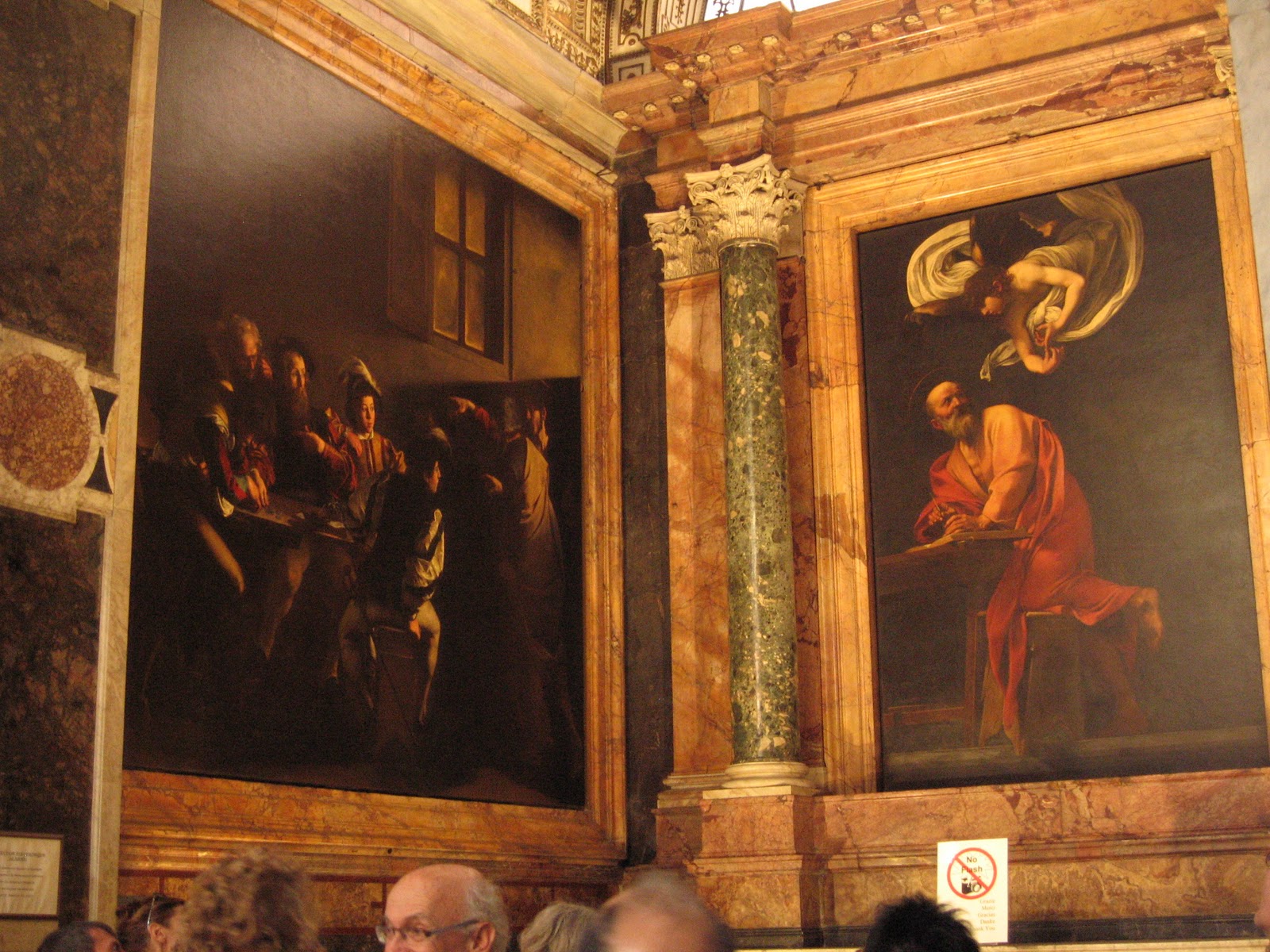
Bob's favorite artist is Caravaggio.  Several Caravaggio's are found in churches and museums in Rome.  These two Caravaggio paintings are in a small church called San Luigi dei Francesi.   The Calling of St. Matthew is on the left and The Inspiration of St. Matthew is on the right.

Trevi Fountain

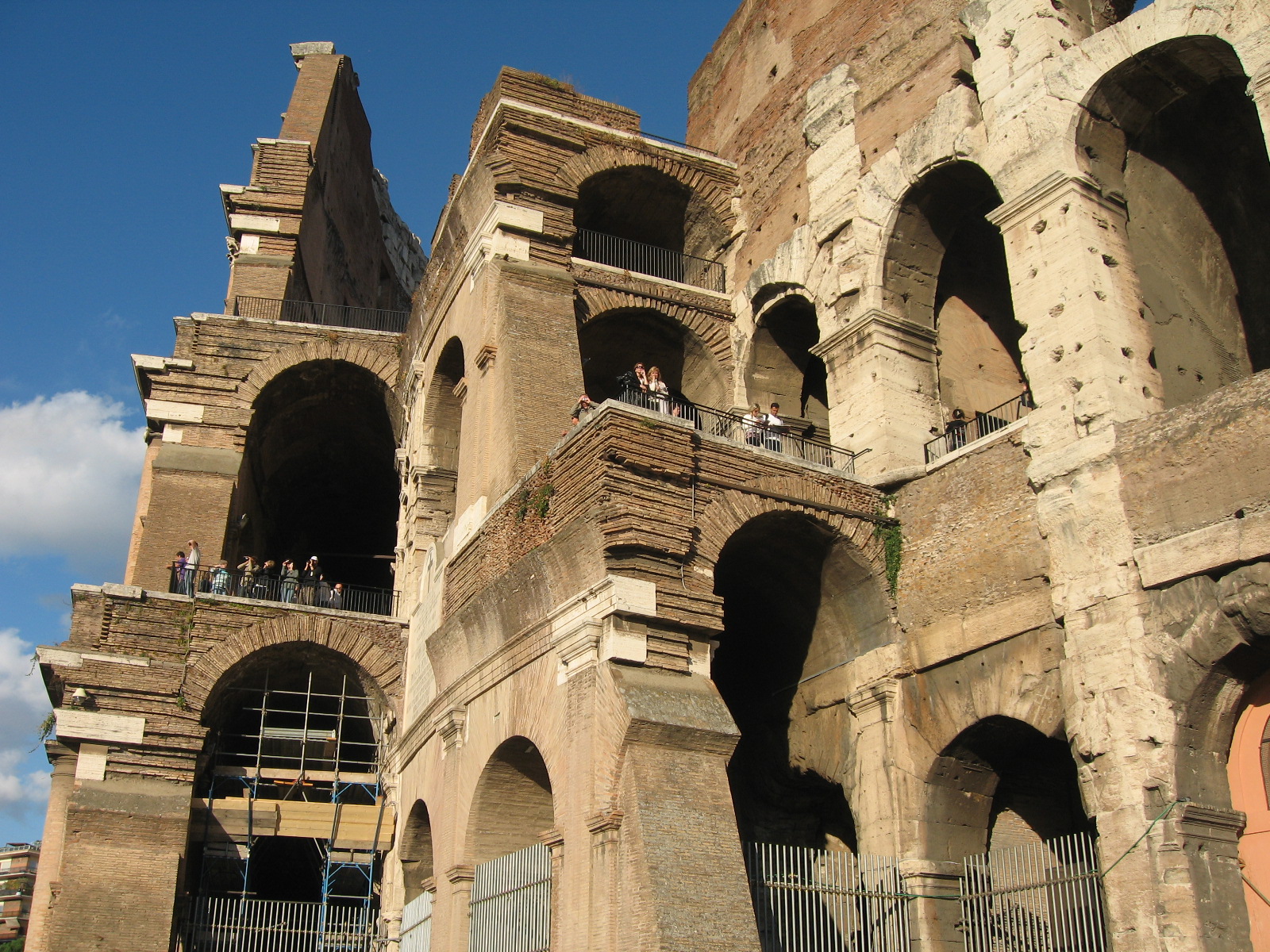
The outside of the Colosseum.  It had 80 entrances and would hold 55,000 spectators.  The spectators could watch animals fighting to the death in the morning, animals killing prisoners at lunchtime  and gladiator battles in the afternoon.  Those Romans were a blood thirsty lot.

The inside of the Colosseum.  These are the below ground rooms that housed prisoners, animals and gladiators. 

The right hand portion of this picture shows the Colosseum with a rebuilt floor to give you the idea of how it once looked. All the seats of the Colosseum were removed centuries ago and reused by past generations in other monuments in the city.  It was an ancient form of recycling.

The three rings to the Colosseum are visible now because part of the walls were destroyed by an earthquake.

The ruins of the Forum.  Modern day Rome is literally built on the ruins of the Romans.  They have a hard time building anything new because whenever they dig down, they find ruins.

Roman Villas overlooking the Forum and Colosseum. 
Ciao!

The Heart of the Renaissance - Florence

Maybe just living in Florence inspires your inner artist as you can see from the sidewalk artist above.


Our stay in Florence was far too brief to take in the enormous array of architecture, sculpture, fresco, and painting that you find literally every few feet in the old city.  I was in a continuous state of awe as I walked the streets trying to take it all in.  Every building seemed to have sculptures and carvings and frescoes.  If you were to just look at one individual piece you would be amazed with the ability of the artist but to have so much to take in had my mind overloaded with details.

Another sidewalk artist recreating a painting.


David outside the Palazzo Vecchio.  The Palazzo Vecchio is the "Old Palace."  This statue of David is a copy, also made by Michelangelo, of the David housed in the Galleria Dell Accademia.

This is the Duomo, or cathedral, of Florence.  The green, pink and white of the cathedral are not painted but are the colors of the Tuscan marble.  The inside of the Duomo was designed by Michelangelo and the pulpit by Donatello. The top of the Duomo has a large dome that is the city's landmark, visible for miles around.

I zoomed in on one small panel carved on the door of the Baptistry.  The details are lovely but it is easily overlooked because it is just one panel on a door with 19 others of equal detail.

The Putto fountain in the courtyard area of the old palace, Palazzo Vecchio.  (1500's)

A covered sculpture garden outside the old palace in the Piazza Della Signoria.

One of the many amazing sculptures in the covered sculpture garden.


The Ponte Vecchio built in 1345 is the oldest bridge in Florence.  Those are colorful shops built onto the bridge so you can shop as you cross the Arno River.  Bob and I had our second favorite gelato ice cream at a shop by this bridge. (We felt it was our duty to sample the gelato frequently.)

Needing a change of scenery from the cultural overload of the heart of Florence, we took the city bus 15 minutes outside of town to Fiesole.  Fiesole is built on a hill overlooking Florence.  It is the site of an Etruscan and Roman temple, bath and theater.

Behind Bob are the ruins of an Etruscan Temple that was later enlarged by the Romans.


Roman Theater

We walked from the ruins further up the hill to a small church and cloister.  From there we had a lovely view of the country side and Florence.


Entrance to the monk's courtyard.

Fascinating and lovely Florence.  Thank you Susan for taking good care of us while we were there and for showing us around.  It was a wonderful visit!